Crime Victims Fund
Current CVF Status
FY 2026
The final VOCA-related spending bill enacted by Congress provided a $1.95 billion cap on the Crime Victims Fund, which included continued funding for
- A 5 percent set aside for tribal victim assistance grants ($97.5 million)
- Office of Inspector General audits ($10 million)
- Transfer to the Office on Violence Against Women ($100 million)
As of enactment of the FY26 CJS appropriations bill, there is a gap between the Crime Victims Fund cap and the available balance. The fund balance is approximately $3.674 billion. After accounting for the $1.934 billion Binance settlement being held in reserve, approximately $1.740 billion remains available, which is about $210 million short of the $1.95 billion cap for FY26 obligations.
Ongoing monthly deposits will continue to replenish the Fund. However, relying on current-year deposits to fund FY26 obligations will reduce the amount available to support future years.
Background Summary
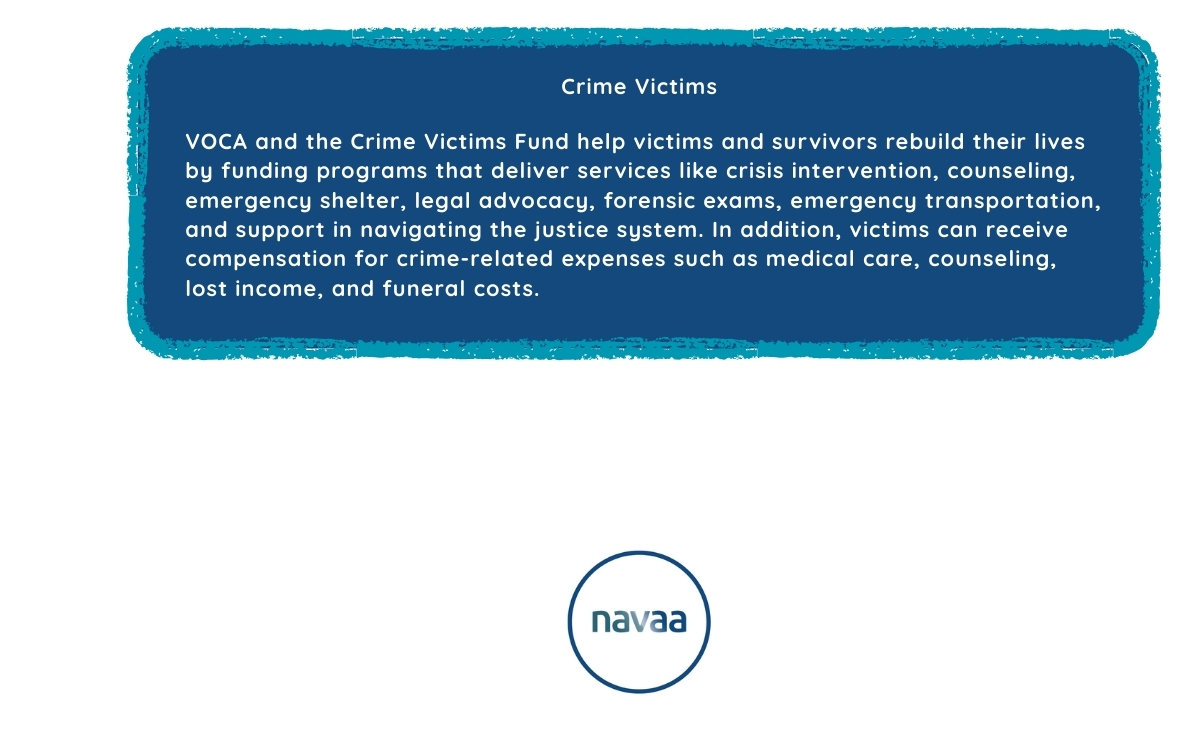
In 2024, victim assistance programs supported by the Crime Victims Fund helped 7.2 million victims of all types of crime.
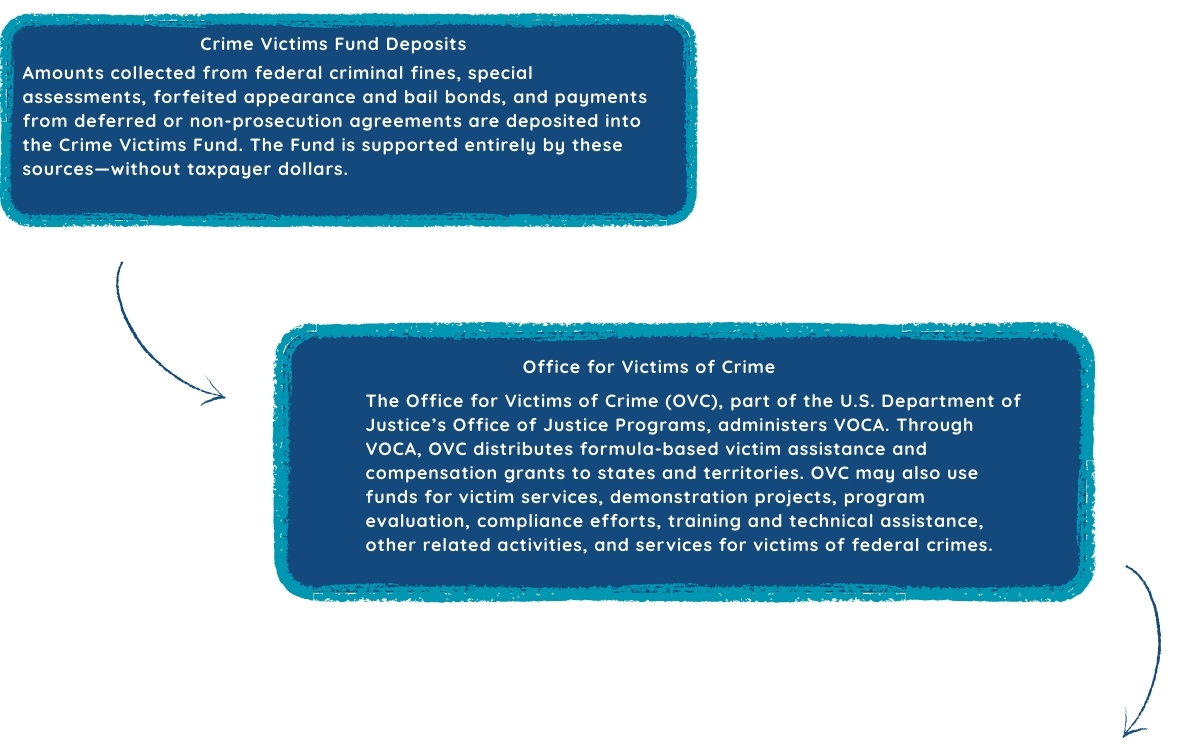
Congress has repeatedly pledged that all amounts deposited into the Fund would remain available in the Fund for victim services. The Victims of Crime Act of 1984 is the Federal government’s only program providing support for programs that serve victims of all types of crime. Each year, Federal criminal fines, forfeited appearance bonds, special assessments, and deferred and non-prosecution agreement payments are deposited into the Crime Victims Fund (CVF). These offender generated revenues — NOT TAXPAYER DOLLARS — are used to support these programs:
- Children’s Justice Act — to improve the investigation and prosecution of child abuse cases;
- U.S. Attorney’s victim/witness coordinators — to help victims involved in Federal criminal prosecutions by funding 230 FTE United States Attorney’s Office victim assistance coordinators;
- F.B.I. victim assistance specialists– to help victims during Federal criminal investigations by funding 212 FTE victim assistance specialists;
- Federal victim notification system — to provide automated notification to victims of the status of Federal criminal investigations and prosecutions and the offender’s status in the Federal prison system;
- OVC discretionary grants — to support victim services, national scope training and technical assistance, demonstration programs, evaluations, compliance efforts, and provide services to victims of Federal crimes;
- State compensation formula grants — to supplement State funds used to reimburse victims of violent crimes for certain costs, including medical expenses, mental health counseling, lost wages, loss of support, and funeral/burial costs;
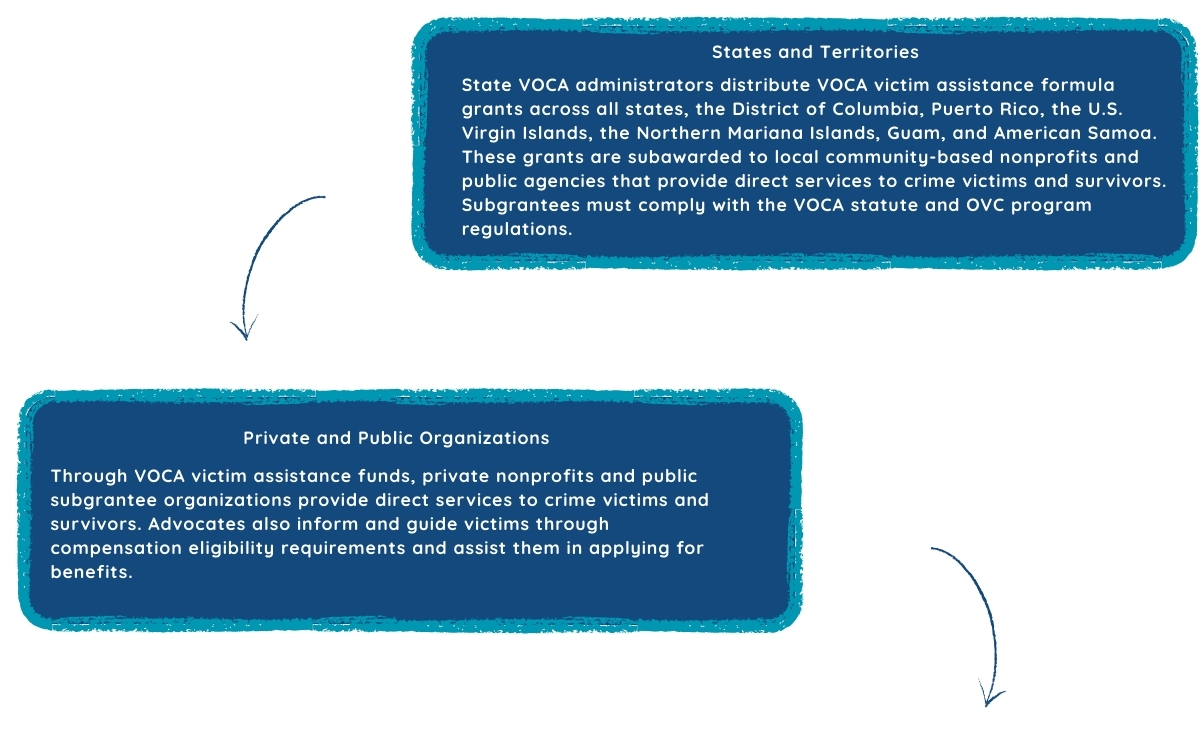
- State victim assistance formula grants — to support direct victim assistance services — such as counseling, emergency shelter, rape crisis centers, and help in participating in the criminal justice system. In 2024, over 6,000 community-based, governmental, and tribal agencies helped over 7 million victims of all types of crime;
- Antiterrorism Emergency Reserve — to replenish a special $50 million reserve to assist victims of domestic and international terrorism and mass violence;
- Child Pornography Victim Reserve Fund – Up to $10 million is reserved to support a one-time “defined monetary assistance” payment to victims of child pornography in lieu of restitution
However, beginning in FY 2012, congressional appropriators began diverting money from the Crime Victims Fund to support other programs that are not authorized under the VOCA statute. These included:
- A portion of the Office of Justice Programs management and administrative costs;
- Since FY 2015, $10 million per year for the Justice Department Office of Inspector General to audit VOCA funded grant programs;
- Since FY 2016 (other than in FY 2023), transfers to the Office on Violence Against Women have ranged from $80 million to $575 million;
- A set aside for tribal victim assistance formula grants of 3 percent of the VOCA cap in 2018 and 5 percent since FY 2019.
Prior to FY 2000, all money deposited into the Crime Victims Fund from the collection of Federal offender-generated revenues was allocated the following fiscal year according to a formula in the Victims of Crime Act (VOCA) statute. Because of wide fluctuations in the amount deposited, beginning in FY 2000, Congress began imposing a limitation or “cap” on the amount of Fund deposits that could be obligated the following year. Congress said it was delaying use of the deposits above the cap in order “to protect against wide fluctuations in receipts into the Fund, and to ensure that a stable level of funding will remain available for these programs in future years.” [H. Rept. 479] Congress also amended the VOCA statute to reflect the preservation of all deposits for future VOCA programs.
VOCA Fix Update
In response to declining deposits into the Crime Victims Fund and to make other adjustments to the Victims of Crime Act statute, Congress, in July 2021, enacted the “VOCA Fix to Sustain the Crime Victims Fund Act of 2021” [Pub. L 117-27]. The principal focus was the addition of payments made under federal deferred and non-prosecution agreements into the Crime Victims Fund.
Beginning in about 2010, as part of its “corporate compliance policies,” DOJ would often agree to suspend or decline criminal prosecutions against corporate offenders if the companies agreed to certain terms and conditions, which frequently included making large monetary payments to the United States Treasury. Because these agreements were not criminal convictions, DOJ determined that the payments could not be deposited in the Fund because they were not specifically listed in the VOCA statute. The VOCA Fix Act remedied that by enumerating these payments among those to be deposited into the Fund. The following amounts have been deposited into the Fund from these payments since the enactment of the VOCA Fix:
| FFY | DPA / NPA |
|---|---|
| 2021 | $224,554,004 |
| 2022 | $531,493,600 |
| 2023 | $263,617,814 |
| 2024 | $435,386,267 |
| 2025 | $1,069,000,000 |
In addition to the additional CVF revenue, the legislation includes other amendments to the VOCA statute. These were:
- Authorization for DOJ to renew or extend VOCA grants beyond the then statutory limit that grants could only be spent in the year of grant award, plus three fiscal years.
- Increases VOCA state crime victim compensation grants from 60 percent to 75 percent of the previous year’s state-funded benefits.
- Prohibits deducting recovery costs or collections from restitution or civil lawsuit subrogation from the calculation of state-funded compensation benefits.
- Allows exceptions for certain conditions and disabilities from the requirement that state compensation programs “promote victim cooperation with the reasonable requests of law enforcement authorities.
- Allows state VOCA assistance agencies to waive subgrantee matching requirements (usually 20 percent of the total VOCA project).
- Requires that the subgrant match requirement be waived during the COVID-19 emergency, which has since ended.
Appropriations Process
Before Congress began imposing a cap on annual Crime Victims Fund obligations, VOCA funding followed a rather predictable process. Since the CVF is, by the VOCA statute, “mandatory spending,” whatever was deposited into the CVF in one year was fully obligated the next year. The CVF was not included in a President’s proposed budget or in Congressional appropriations acts. That all changed in 2000, when Congress, for the first time, delayed CVF obligations “to protect against wide fluctuations in receipts into the Fund, and to ensure that a stable level of funding will remain available for these programs in future years.” [House Report 105-479] Since then, Congress has set the annual “cap” on CVF obligations and VOCA advocates have had to pay close attention to the Congressional appropriations process.
| FFY | Prev. Year Deposits | Cap | FFY | Prev. Year Deposits | Cap | |
|---|---|---|---|---|---|---|
| 2000 | 985,185,354 | 500,000,000 | 2013 | 2,795,547,045 | 730,000,000 | |
| 2001 | 776,954,858 | 537,500,000 | 2014 | 1,489,582,811 | 745,000,000 | |
| 2002 | 544,437,015 | 550,000,000 | 2015 | 3,591,493,390 | 2,361,000,000 | |
| 2003 | 519,466,480 | 600,000,010 | 2016 | 2,639,961,928 | 3,042,000,000 | |
| 2004 | 361,341,967 | 621,312,498 | 2017 | 1,486,357,496 | 2,573,000,000 | |
| 2005 | 833,695,013 | 620,000,000 | 2018 | 6,584,504,474 | 4,436,000,000 | |
| 2006 | 668,268,054 | 625,000,000 | 2019 | 444,832,641 | 3,353,000,000 | |
| 2007 | 649,631,046 | 625,000,000 | 2020 | 495,306,240 | 2,641,000,000 | |
| 2008 | 1,017,977,475 | 589,998,183 | 2021 | 503,000,000 | 2,015,000,000 | |
| 2009 | 896,316,825 | 635,000,000 | 2022 | 774,329,903 | 2,600,000,000 | |
| 2010 | 1,745,677,602 | 705,000,000 | 2023 | 822,151,551 | 1,900,000,000 | |
| 2011 | 2,362,337,940 | 705,000,000 | 2024 | 1,386,223,934 | 1,353,000,000 | |
| 2012 | 1,998,220,205 | 705,000,000 | 2025 | 2,538,155,277 | 1,900,000,000 |
Although the law requires the President to submit a budget between the first Monday in January and the first Monday in February, that is often deferred, particularly when a new President takes office and when the incoming President is of a different political party. For example, President Trump did not submit his 2026 budget proposal until May 2, 2025.
There are 12 Congressional Appropriations subcommittees, each of which is given certain amounts to fund every agency and program under its jurisdiction. For VOCA, in the House and Senate, the relevant subcommittees are the Commerce, Justice, Science and Related Agencies (CJS) subcommittees whose jurisdiction includes the Department of Justice and the CVF. While the subcommittees may take Presidential budget submissions into consideration, they are not bound to do so and usually develop their own spending bills pretty much from scratch.
Although Federal fiscal years begin October 1, final enactment of spending bills have almost always missed this deadline. In such cases, Congress may pass one or more continuing resolutions (CR) that simply continues current spending levels for a set period of time. If they fail to do that, as happened once recently, the federal government shut downs. Sometimes, the CJS bill is enacted as a standalone bill and often as part of a larger, consolidated appropriations act that combines several or all 12 spending bills. In some years, when Congress cannot agree on a new spending package, it enacts a full-year CR. (In 2025, Congress enacted a full-year CR which included an “anomaly” that increased the CVF cap.) Indeed, since 2001, CJS appropriations bills have been on average 3.5 months late. This is important for VOCA-funded programs since DOJ cannot calculate the amounts of each year’s allocations, including state victim assistance formula grants, until a final, full-year spending bill is enacted. That, in turn, has meant that state grants have not been awarded until 11 months after the beginning of the fiscal year, reducing the amount of time states have to expend each year’s grant.
Funding Flow